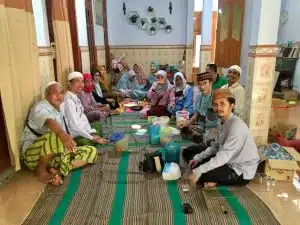
The eleventh post in our Celebrating Alumni profile series is Bambang Arief Rahman, a 2008 AIMEP alumnus. Bambang is the Director of the Assalam 2 Modern Islamic Boarding School in Tepus, Gunungkidul, Yogyakarta. Bambang is currently completing his PhD at Hiroshima University in Japan.
Read Bambang’s story below:
Bambang Arif Rahman

My father sent me to a modern pesantren (Islamic boarding school), where we were not only taught Islamic studies, but also biology, physics, mathematics, and modern civilization. And as I got older, my ambition was to broaden my horizons by visiting other countries.
I did my Bachelor’s degree in Arabic Studies, followed by a Master’s degree in Islamic Principles and Philosophy. But even though I went back to my pesantren as a teacher, I still hoped to explore the outside world.
My first trip out of Indonesia was to Al-Azhar University in Cairo, Egypt. For me, it was exotic, but not that different to Indonesia. Later, I accompanied a group of Indonesian senior high school students on an exchange visit to Japan, and I was really impressed by the cleanliness, order, and modernity. This only strengthened my intention to study in different countries, and at that time I successfully applied for the AIMEP.

At the same time, I was awarded a Chevening scholarship to do my second Master’s degree in Religion and Public Life at Leeds University. This meant I had two weeks on the AIMEP just before flying to the UK!
I really enjoyed my time in Australia. It was enlightening to be able to interact with non-Muslims such as Jews and Christians, and to build peaceful relationships with them. I also met people who didn’t believe in any God, but even though we didn’t have the same beliefs, we could still respect and interact with each other.

When I was in Australia, I didn’t have the privileges I have in Indonesia. For example, it was not always easy to find halal foods or somewhere to pray. But this experience of being in a minority was interesting for me, as it made me realise the importance of showing respect and understanding to minorities back in Indonesia.
In Leeds, it was easy for me to maintain my Muslim practices, but other things were difficult, including the cold weather and the snow! Also, everyone seemed to be rushing everywhere, compared with Indonesia where life is a bit slower. Another aspect which was hard for me to get used to was when I saw people openly showing physical affection to boyfriends and girlfriends, which is rare in Indonesia. But eventually I discovered that I could respect other people, even when their behaviour was different from what I was used to.
I was quite surprised to find that the UK was so multicultural because I had always assumed that it was only a Christian country. At first, I found it difficult to be confident enough to relate to people from different cultures. Everyone else seemed to be smarter and more organised than me! But after some time, I made more of an effort to be involved, and my cultural experience was enriched.
When I came back to Indonesia, I was offered a job as principal of my pesantren, which has 1100 students. Recently, I was entrusted with starting a new branch of the school as well.

In 2016, I spent three and a half years in Japan, as my wife had gone there to study for her PhD. I also started a PhD there, on the development of multicultural education in Islamic boarding schools, with an emphasis on how the pesantren education system can encourage interaction and communication with non-Muslims and other cultures, and how it can broaden the opinions and insights of students. Unfortunately, the COVID-19 pandemic arrived before I could finish, but I am hoping that I will be able to finish it at some point!
While I was in Japan, I created a study tour exchange program with my pesantren, called Japan Overseas Study. In this program, our students visit a senior high school in Japan, where they present some cultural practices such as traditional Indonesian dance. As a result, they make contact with Japanese students and can continue to communicate with them through social media.

My experiences with both the AIMEP and my studies abroad had a big impact on me, and I always encourage our students to go on exchange programs or try to continue their studies overseas. At first, some of the more traditional teachers were suspicious that I intended to liberalise the pesantren, but I explained to them that we need to be open-minded and to realise that we are not the only ones living on this earth.
We have also started to encourage students to learn both Arabic and English – Arabic to maintain our Islamic tradition, and English to be able to communicate with global citizens. Now it’s common for our students to go on to study overseas, which makes me very proud.
Bambang Arif Rahman
Solo, Central Java
AIMEP 2008